What 25 Years of Industry Signals Reveal
Over the past 25 years, the AEC industry hasn’t changed overnight. It has shifted gradually—through signals many of us didn’t recognize until they became impossible to ignore.
As a strategic growth consultant working with architecture, engineering, and construction firms, I spend a lot of time studying those signals. At The Flamingo Project, that means helping firms understand how market shifts should influence their growth strategy, business development, and planning.
That perspective is also shaped by my work with the SMPS Foundation, where we support research focused on where the industry is headed. Recently, I had the opportunity to dig into insights from the Foundation’s Emerging Trends research—not just to identify trends, but to better understand what’s actually driving change.
As I worked through the data, one question kept surfacing:
“Why does marketing and business development in AEC feel so different today than it did even just ten or fifteen years ago?”
Most firm leaders sense that something in the market is shifting:
- Backlogs fluctuate.
- Clients ask different questions.
- The competitive landscape feels less predictable than it once did.
- Expectations are higher.
- Risk is distributed differently.
When I stepped back and mapped the major shifts shaping the industry over the past two decades, a clear pattern emerged.
The evolution of AEC marketing and business development isn’t random. It reflects changes in client expectations, industry forces, and the tools firms use to compete.
The timeline below captures those shifts—era by era, so you can see how small changes accumulated into something much bigger, and what they mean for how your firm competes next.
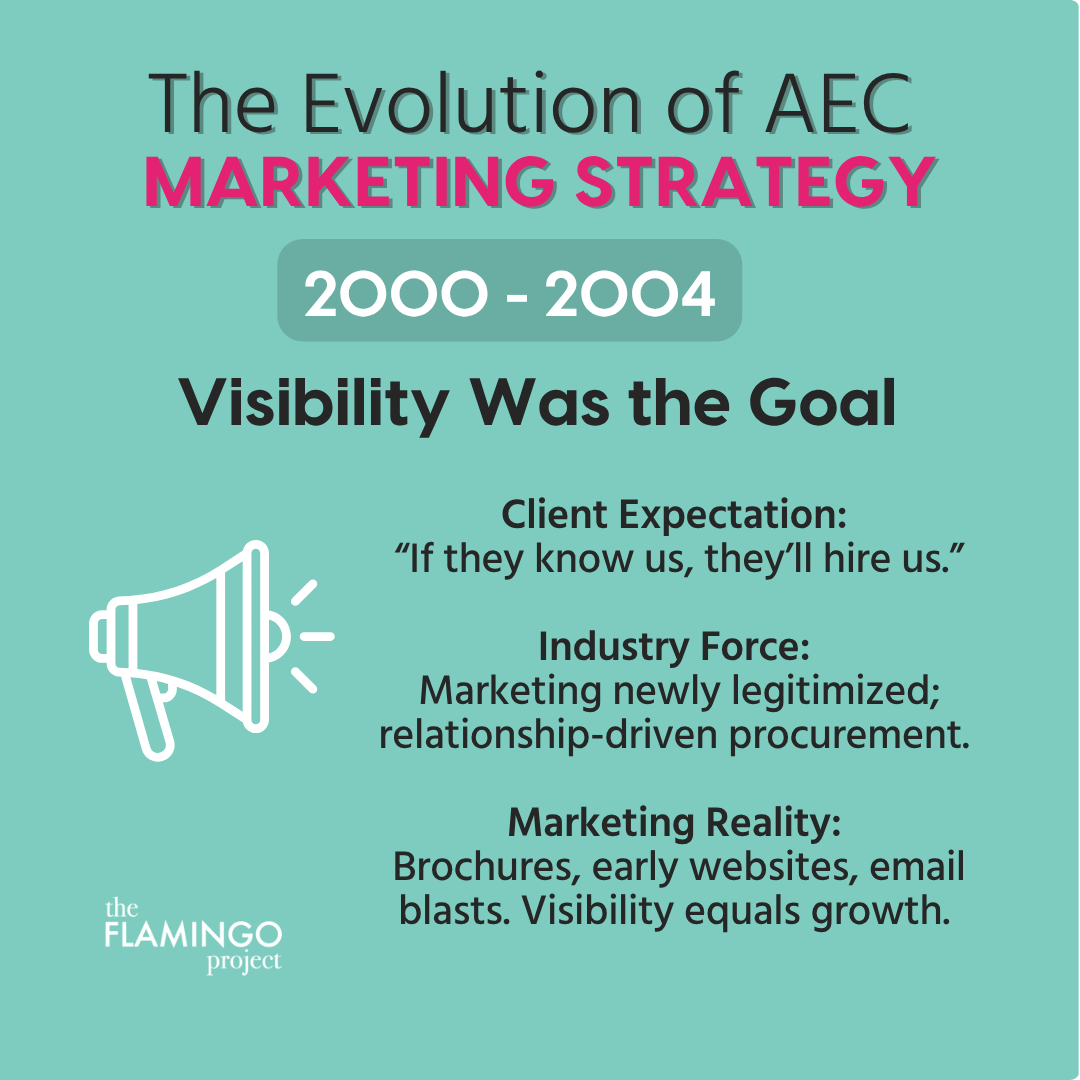
2000–2004 Visibility was the Goal
At the start of the 2000s, relationships and visibility drove growth. If clients knew you and trusted you, you were likely to be in the running for work.
Marketing’s role was primarily about proximity—helping firms stay visible through conferences, printed brochures, early websites, and email newsletters. Many of those early sites were built using tools like Dreamweaver, and digital marketing was still in its infancy.
The expectation from clients was simple: “If we know you, we trust you.”
Marketing was largely about reinforcing reputation and presence.
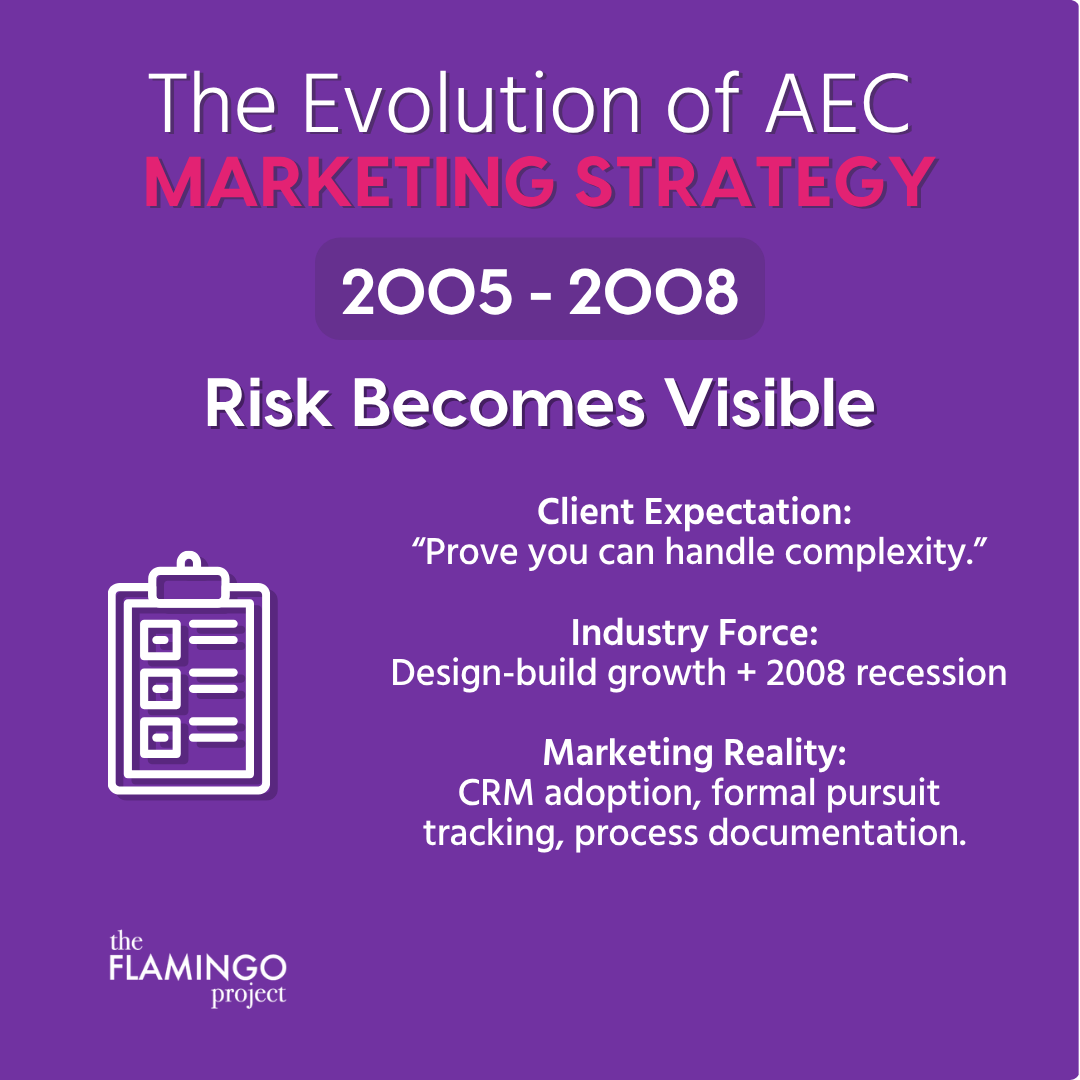
2005-2008 Risk Becomes Visible
As projects became more complex, clients began paying closer attention to risk. The growth of design-build delivery models and the economic pressures leading up to the 2008 recession changed how firms evaluated partners. Clients began asking tougher questions to get to the heart of the matter: “Can this firm handle complexity?”
Marketing and business development responded by introducing more structure, including, CRM systems, formal pursuit tracking, and clearer documentation of processes and capabilities.
The shift had begun.
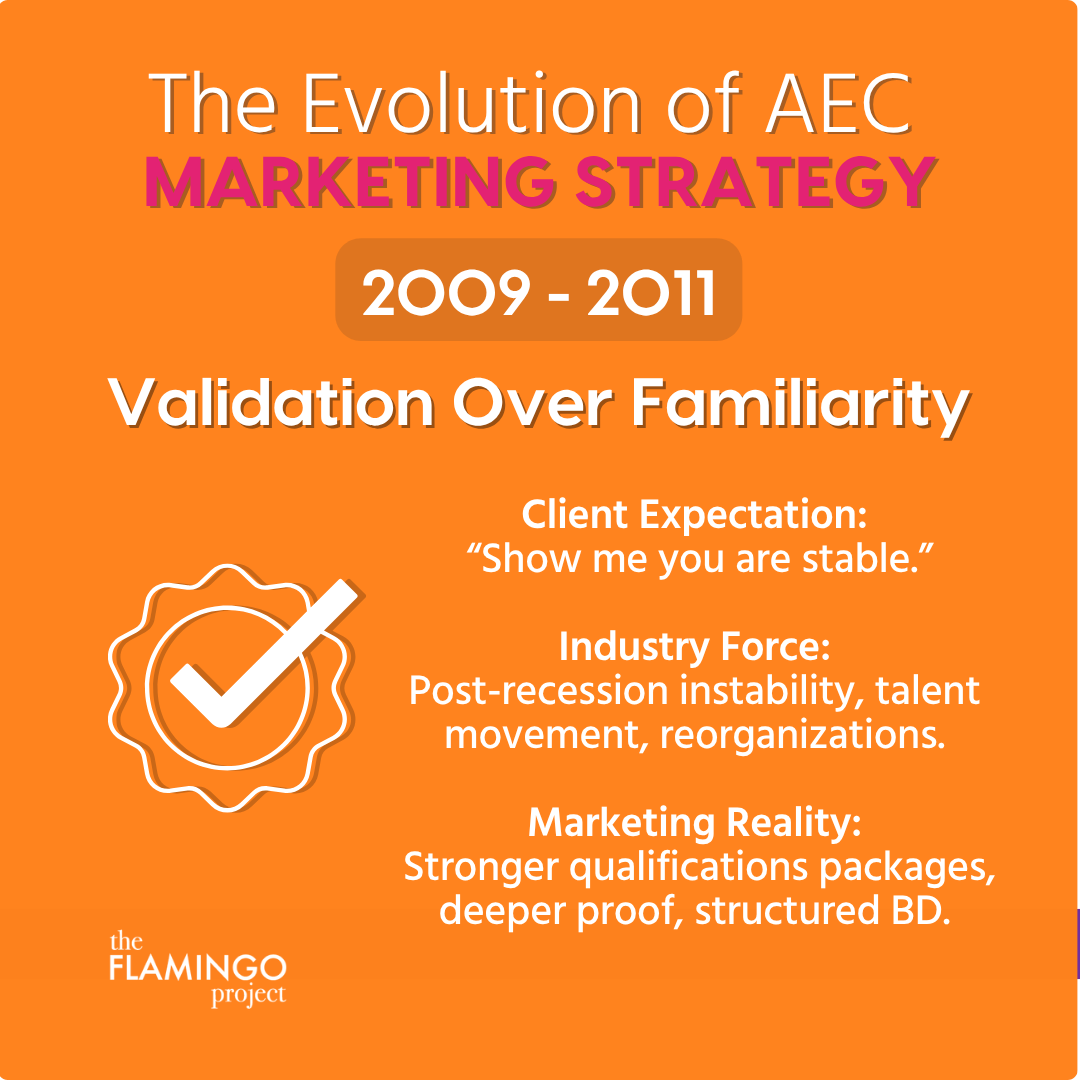
2009–2011 Validation Over Familiarity
The 2008 recession fundamentally reshaped how clients made decisions. Relationships still mattered, but they were no longer enough. Clients wanted proof.
They wanted to know a firm was stable, capable, and prepared to deliver results despite economic uncertainty. At the same time, talent movement and industry restructuring changed buying relationships across the market.
Marketing and BD teams responded by strengthening RFQ packages, building deeper project narratives, and creating more structured business development strategies.
Trust was no longer assumed, it had to be proven.
2012–2014 Credibility Over Claims
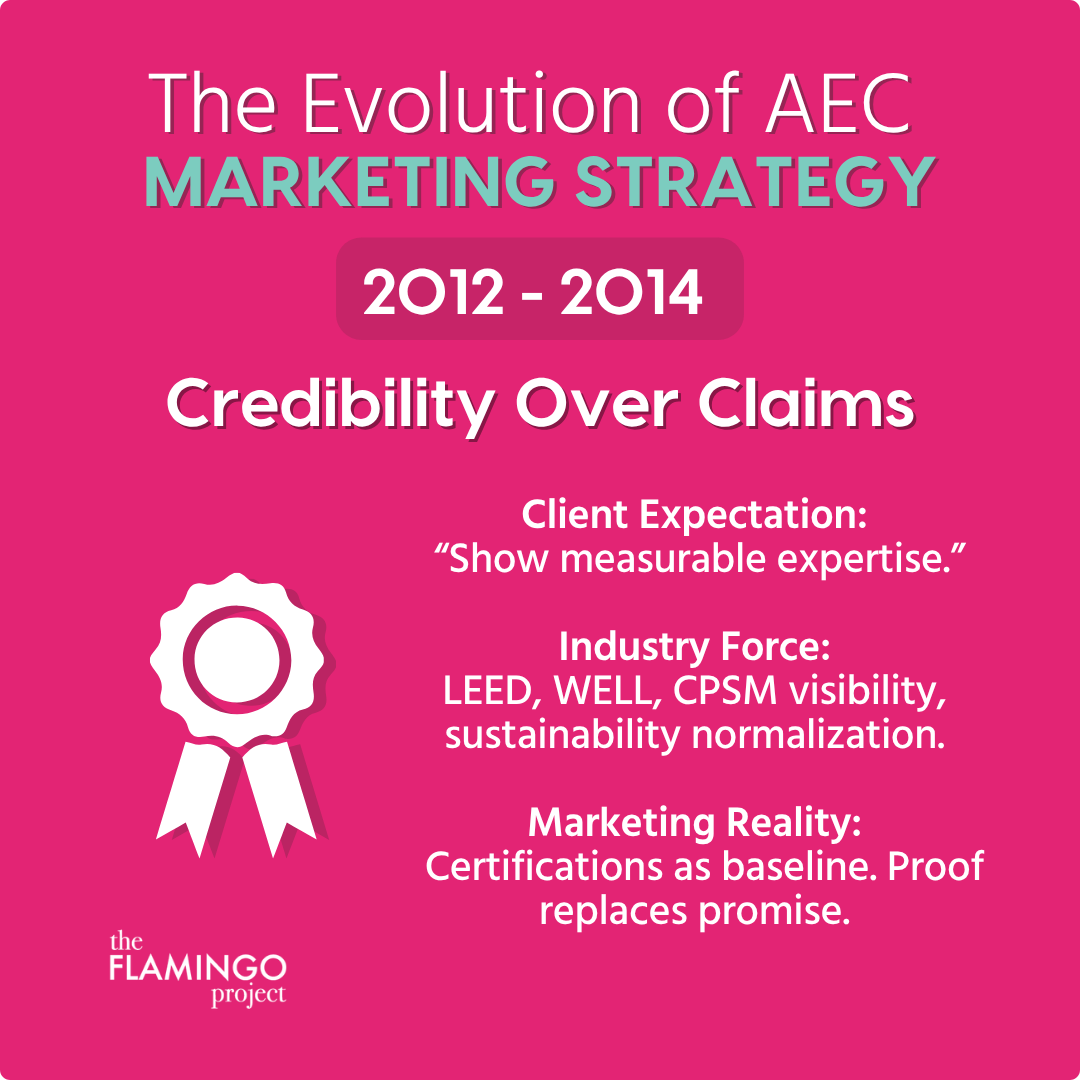
By the early 2010s, credentials became a major differentiator. Certifications such as LEED, WELL, and CPSM gained visibility across the industry. Sustainability and specialization were becoming normalized expectations rather than unique selling points.
Clients wanted measurable expertise, and marketing teams responded by emphasizing credentials, performance metrics, and proof-based messaging. The era of simply promising capability was fading.
Credibility had become the baseline.
2015–2017 Experience Signals Appear
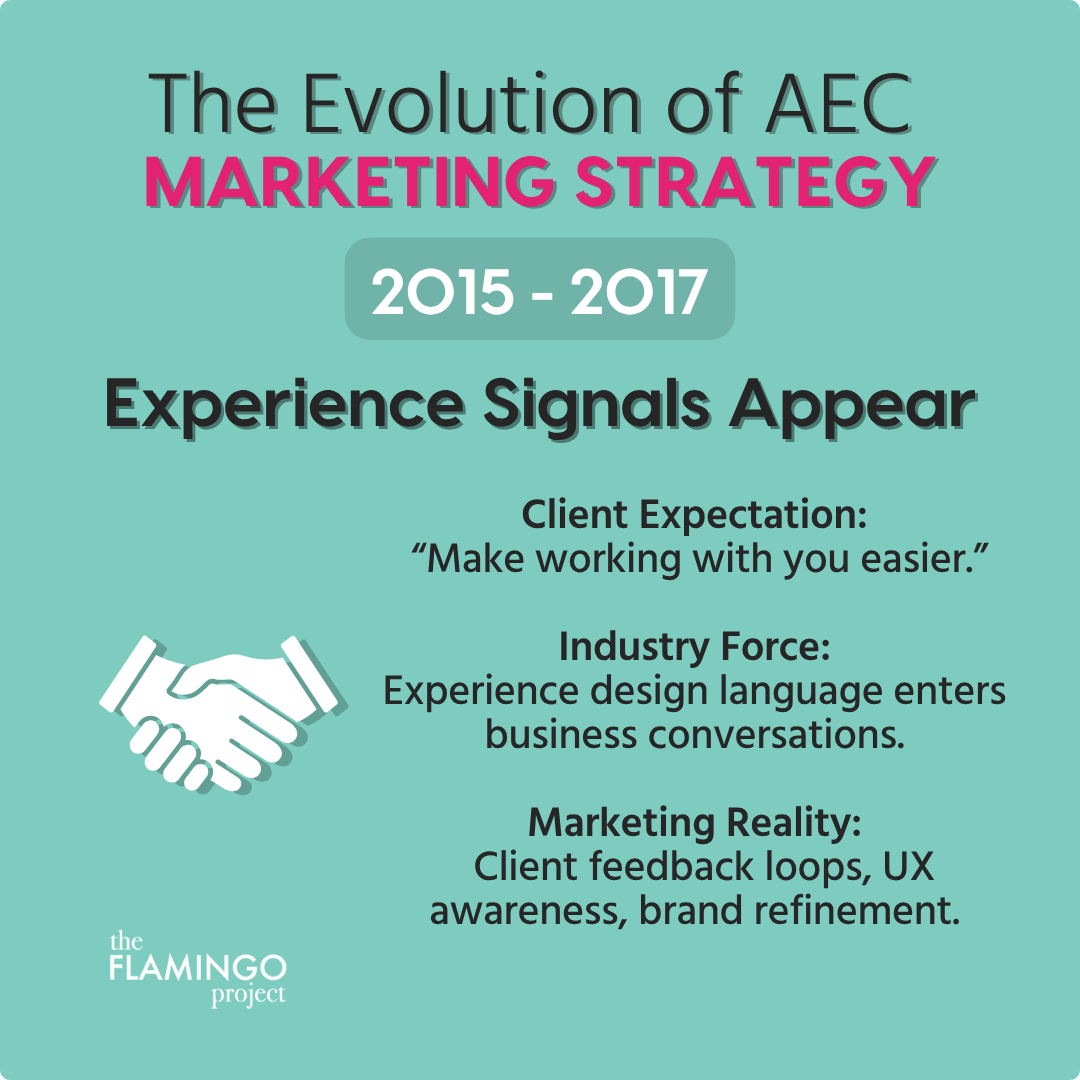
Around the mid-2010s, something subtle but important began to change. Clients started evaluating not just what firms could do—but how it felt to work with them. Experience design concepts entered business conversations. Coordination, responsiveness, and ease of collaboration became part of the evaluation process.
Marketing responded by paying closer attention to client feedback loops, brand refinement, and how firms communicated their approach to collaboration. Working with a firm should feel easier.
For the first time, experience became a signal.
2018–2019 Experience Becomes Visible
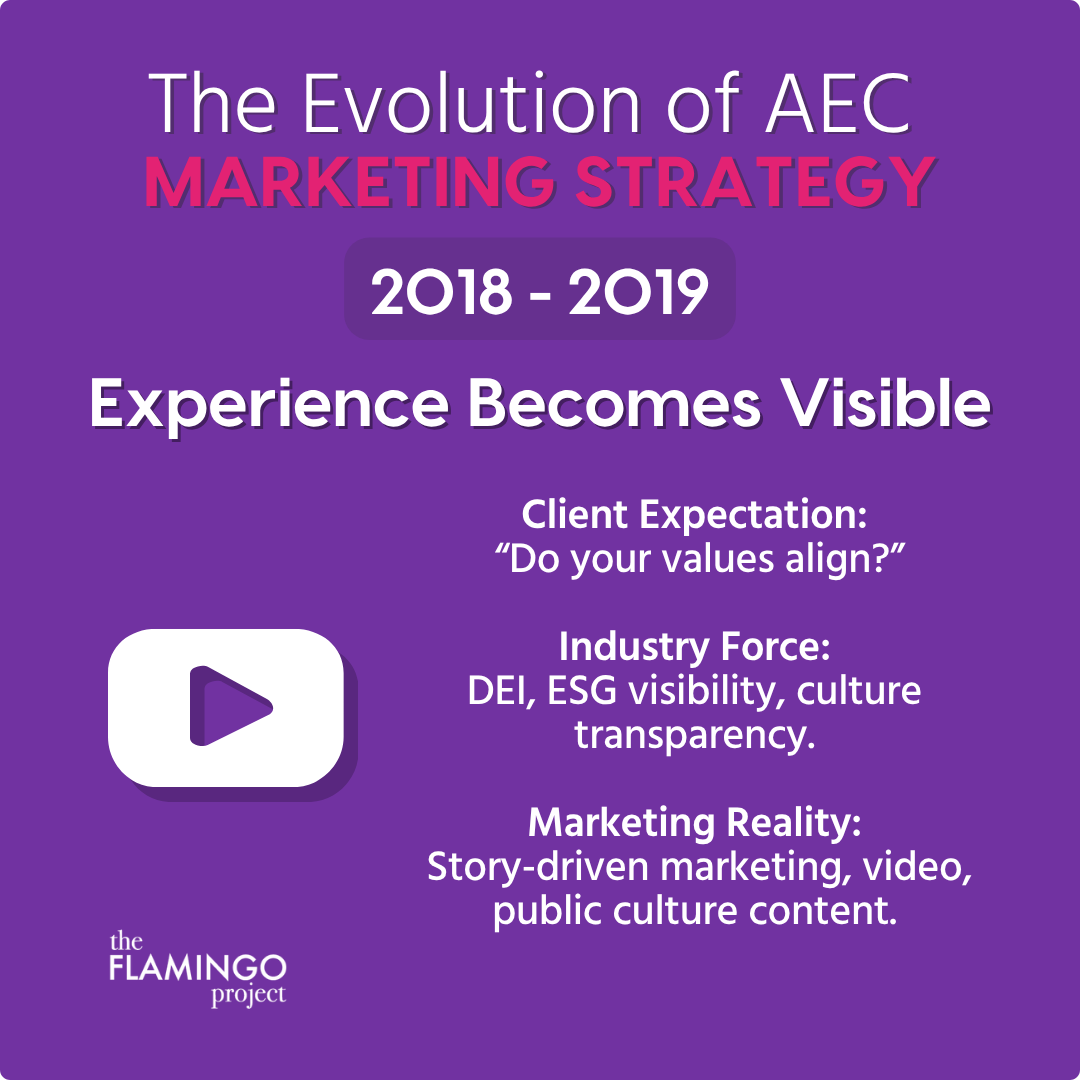
Soon after, culture and values moved into the spotlight. Clients increasingly asked whether their partners shared similar priorities around transparency, collaboration, and social responsibility. DEI conversations, ESG visibility, and organizational culture became more public—and more relevant to selection decisions.
Marketing began shifting toward story-driven communication, video content, and visibility into firm culture.
Experience was no longer abstract. It was visible.
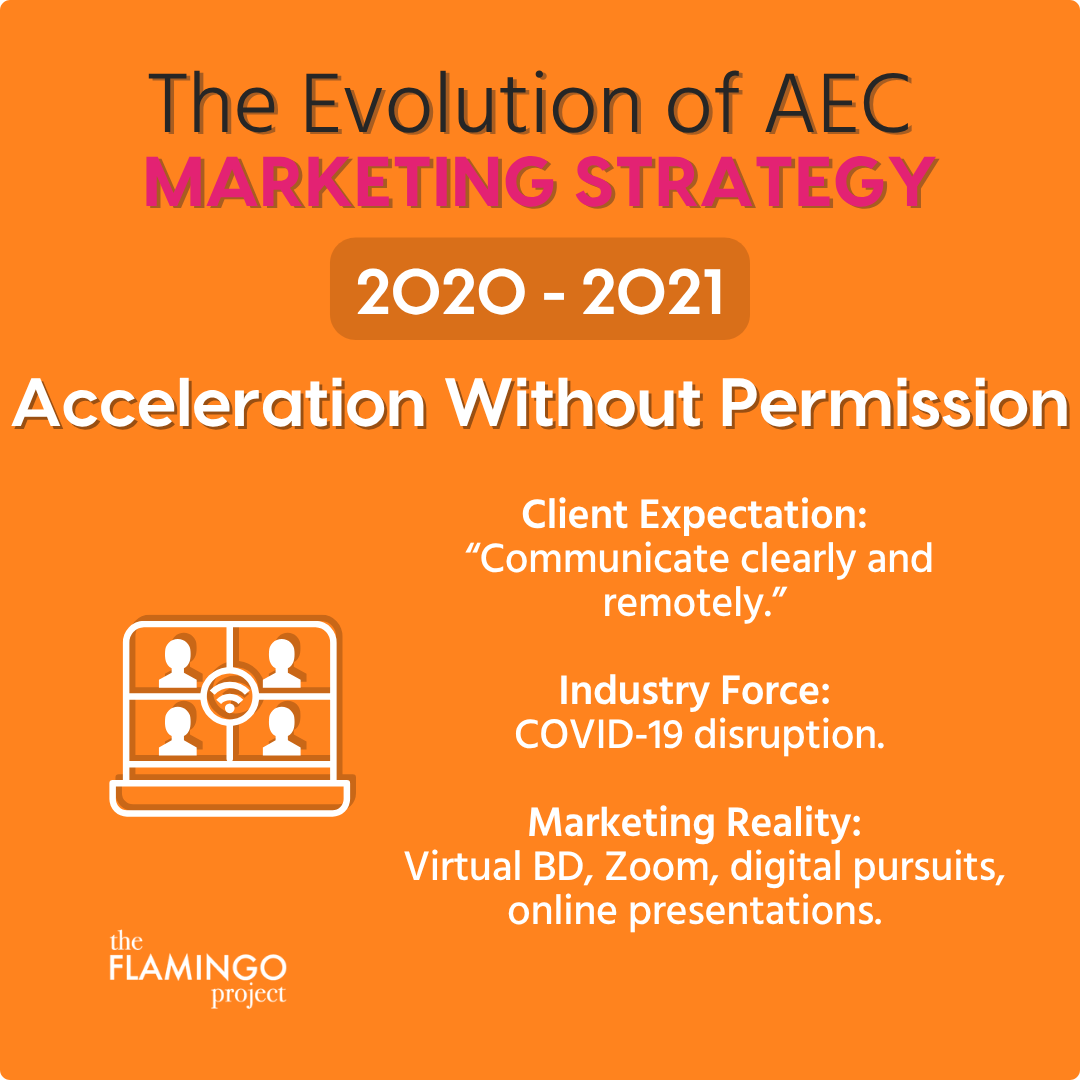
2020–2021 Acceleration Without Permission
Then came COVID-19.
While the pandemic didn’t necessarily create new trends, it accelerated nearly every shift already underway. Communication became fully digital. Business development went virtual almost overnight. Client meetings, project interviews, and pursuit strategies moved onto platforms like Zoom.
Clients expected firms to communicate clearly, remotely, and efficiently.
Marketing teams quickly adapted by developing virtual pursuit strategies, digital presentations, and new ways to maintain relationships without physical proximity.
The pace of change increased dramatically.
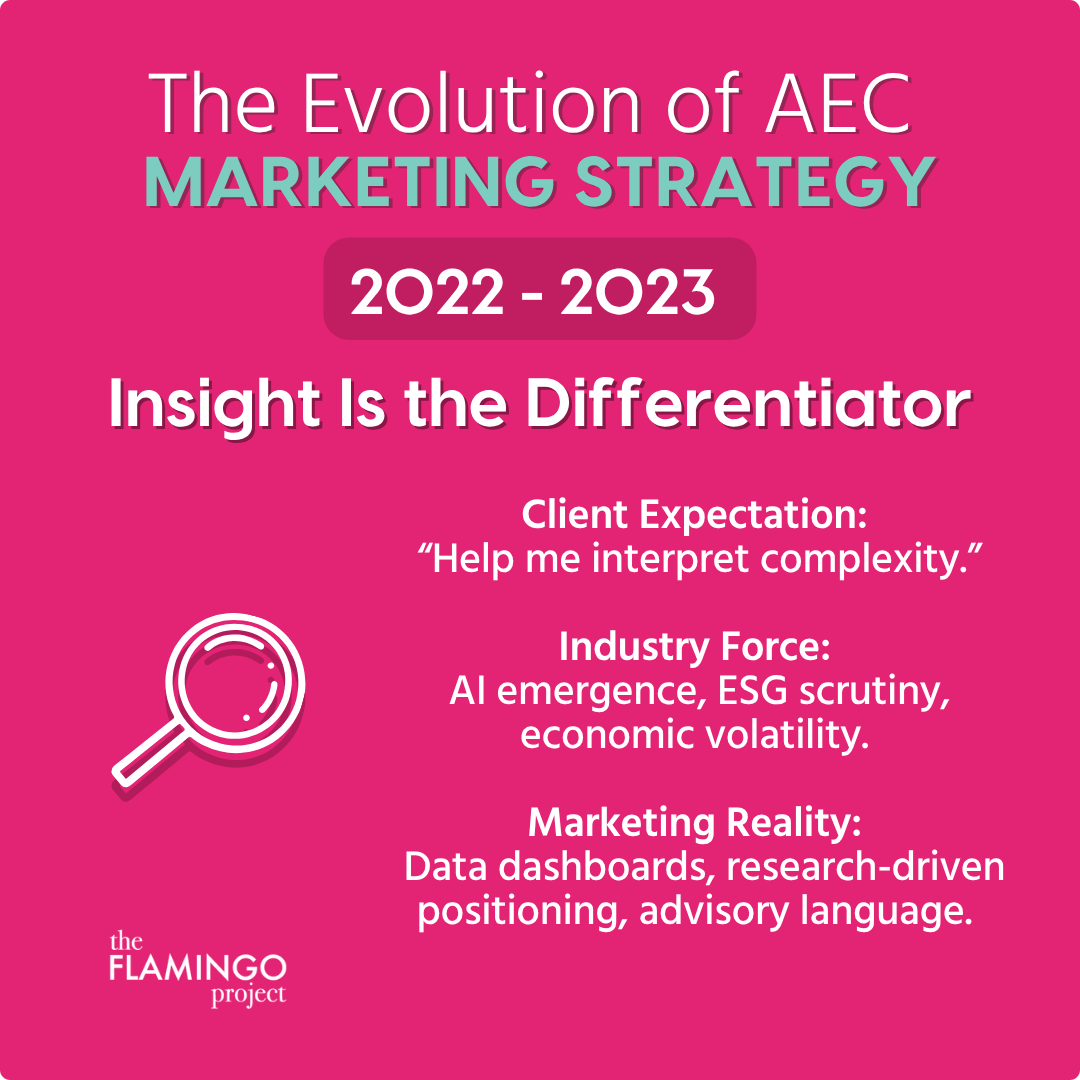
2022–2023 Insight Is the Differentiator
As markets stabilized, another shift became clear. Clients were no longer just looking for information; they were looking for interpretation, and firms that could translate complexity into insight gained an advantage. Research, data dashboards, and market intelligence became more central to strategy.
Marketing began moving beyond communication and into advisory territory helping leadership teams understand where markets were moving and how to position the firm accordingly.
Insight had become the differentiator.
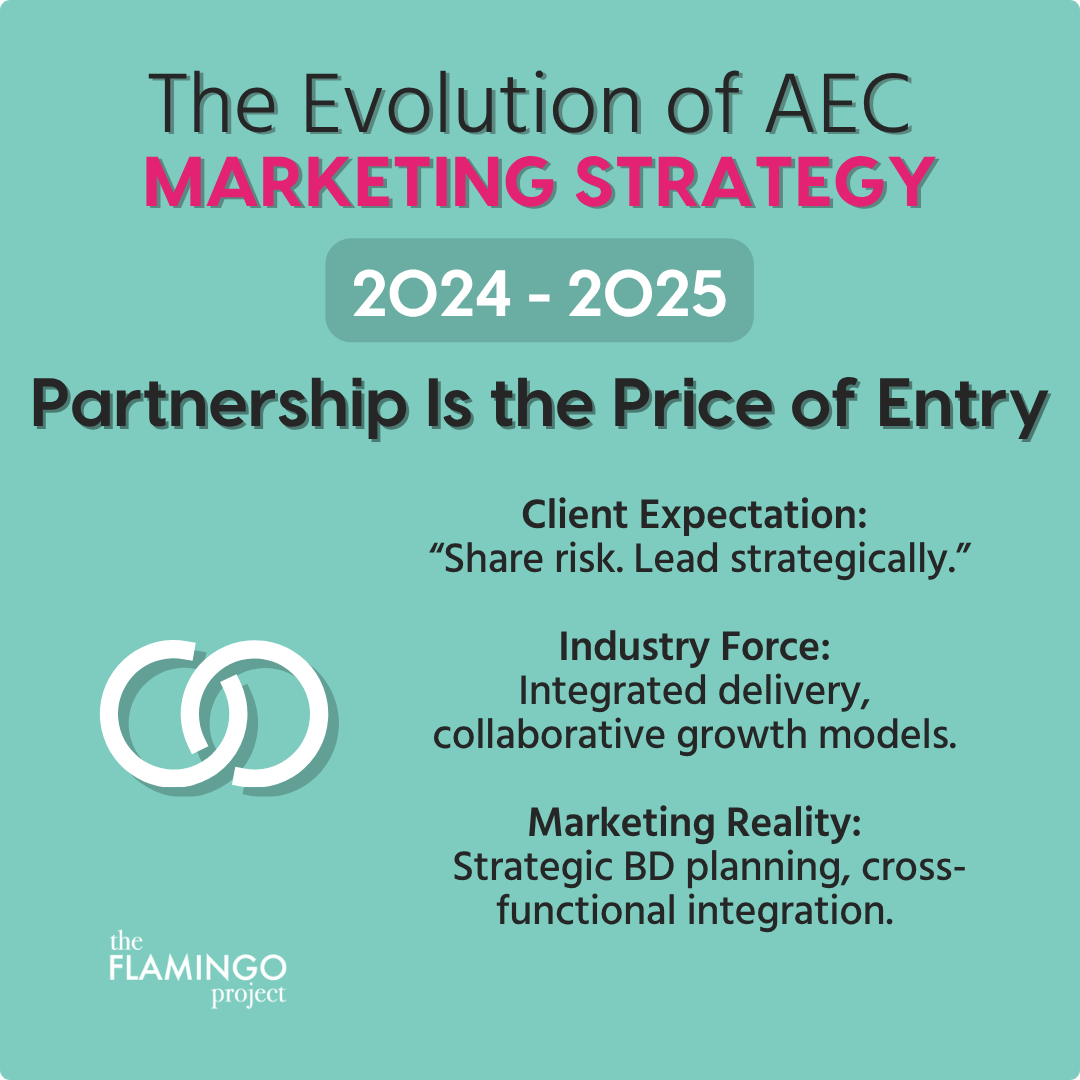
2024–2025 Partnership Is the Price of Entry
Today, collaboration sits at the center of growth. Integrated delivery models, shared risk structures, and cross-functional teams are becoming standard expectations across the industry. Clients increasingly expect firms to help lead strategically—not just execute technically.
Which means, marketing and business development are no longer just outward-facing roles. They are becoming connective tissue inside the firm—helping leadership teams interpret market signals, align capabilities, and build partnerships that support long-term growth.
Partnership is no longer optional. It’s the price of entry.
What This Means for Firm Leaders
Looking across these eras reveals something important. The evolution of AEC marketing isn’t really about marketing. It’s about how risk moves through the industry. Twenty-five years ago, visibility and relationships were often enough to win work. Today, clients expect deeper insight, stronger collaboration, and measurable expertise.
In other words, the expectations placed on AEC firms have expanded significantly—and so has the strategic role of marketing and business development. But perhaps the most important insight from this timeline isn’t historical. It’s practical.
The firms that struggle the most are rarely the ones that fail to plan. More often, they’re the ones who fail to recognize signals early enough to respond.
Leadership teams sense that something in the market is shifting—changes in backlog, evolving client expectations, or new delivery models. But strategy conversations frequently wait until annual planning cycles. By the time those discussions happen, the signal has already become a structural change.
What Signals Are You Seeing?
I help AEC firms make sense of what’s changing and what it means for their planning, positioning, and growth. When you step back and look at these shifts together, it becomes less about reacting to what’s happening today and more about understanding what’s coming next. Most leaders already sense that something is shifting.
The question is whether we’re paying attention to the right signals—and early enough to act on them.
If this sparked questions about where your firm is headed—or how to approach planning with more clarity—connect with me.
Whether the focus is strategic planning, business planning, or market research, the goal is the same: making decisions with a clearer view of the market.